

No one expected a leadership forum about faith, sportsmanship, and ethics to detonate into one of the most polarizing viral moments of the year, yet that is exactly what unfolded under the bright lights of the packed arena.
The "Global Sports Leadership & Ethics" conference was supposed to be a polished exchange of ideas, blending locker room discipline with spiritual conviction, until a single accusation cracked the atmosphere wide open.

Joyce Meyer, one of the most recognized and influential Christian voices in the world, suddenly rose from her seat, turned sharply toward NFL star T. J. Watt, and delivered a line that stunned even her supporters.
"You're not a Christian," she declared, her voice cutting through the auditorium with a force that felt less like discussion and more like a verdict pronounced before a global congregation.
For a split second, confusion rippled through the crowd as thousands tried to process whether this was scripted theater, a misunderstood comment, or an unfiltered moment of raw conviction.

Watt, known more for bone-crushing tackles than theological debates, slowly turned around with an expression that seemed almost disarmingly calm in contrast to the rising tension around him.
He did not clench his jaw, he did not fire back defensively, and he did not attempt to match the intensity of a preacher accustomed to commanding massive arenas.
Instead, he smiled faintly, stepped toward the microphone, and delivered exactly seven words that would ignite social media within minutes of the clip hitting the internet.
"Only God decides who I am."

The sentence was simple, almost understated, yet the impact was seismic, creating a silence so complete that the hum of stage equipment became suddenly audible.
Someone in the front row audibly gasped, and several audience members exchanged stunned glances as though they had just witnessed a collision between two different worlds.
In that frozen pause, the power dynamic shifted, not because one voice was louder, but because restraint met accusation with a boundary that was impossible to ignore.
Within hours, the hashtag #OnlyGodDecides exploded across platforms, with supporters praising Watt's composure and critics questioning whether faith had been reduced to a viral soundbite.

Comment sections turned into battlegrounds, with some calling Meyer courageous for defending doctrinal purity while others accused her of gatekeeping spirituality in a way that felt exclusionary and public.
The debate quickly transcended the individuals on stage and morphed into something larger, a referendum on who has the authority to define belief in an age where identity is constantly scrutinized.
Supporters of Meyer argued that spiritual leadership sometimes requires uncomfortable truth-telling, even if it risks backlash in a culture that often prioritizes popularity over conviction.
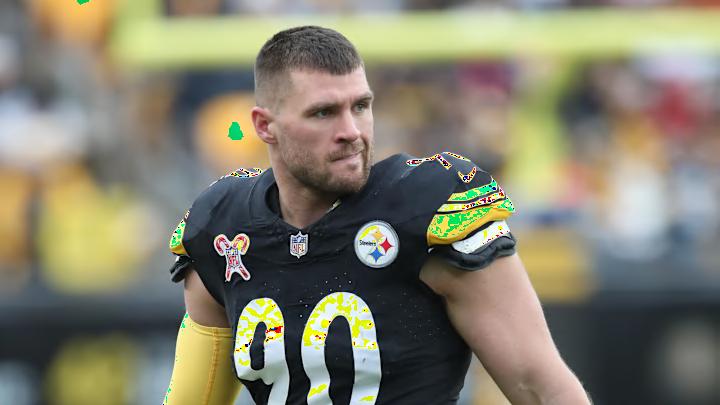
Meanwhile, Watt's defenders framed his response as the embodiment of humility under pressure, proof that strength does not require retaliation and that faith can be asserted without aggression.
The seven words became a digital mantra, printed on graphics, remixed into reels, and quoted by celebrities who rarely comment on religious disputes but sensed the cultural electricity of the exchange.
Critics, however, warned that viral moments flatten complex theological debates into simplistic slogans, turning nuanced faith conversations into trending hashtags designed for maximum engagement.

Yet perhaps that simplification is precisely why the clip traveled so far and so fast, because in a fragmented media landscape, clarity — even controversial clarity — cuts through the noise.
For many young viewers, Watt's reply symbolized a generational shift away from institutional gatekeeping and toward a personal, direct relationship with belief unmediated by public judgment.
Older audiences, however, questioned whether the applause surrounding his response reflected a growing discomfort with spiritual accountability and communal standards of doctrine.
The clash exposed a deeper tension between platform authority and personal testimony, between sermons delivered from pulpits and convictions formed in private moments of struggle.
Observers noted that Watt's athletic reputation added a layer of intrigue, as fans who tune in for touchdowns and tackles suddenly found themselves debating theology in sports forums.
Sports analysts who typically dissect defensive strategies were now parsing the cadence of a seven-word sentence, illustrating how quickly cultural lines blur in the era of constant connectivity.
Meanwhile, theologians appeared on podcasts and livestreams, debating whether public rebukes align with scriptural precedent or risk alienating those still exploring their faith journey.
Public relations experts pointed out that neither side likely anticipated the scale of the fallout, yet both now occupy symbolic roles in a broader cultural confrontation.
Was Meyer defending orthodoxy in a moment of necessary boldness, or did her declaration cross into a territory where personal belief becomes subject to public shaming.
Was Watt's response a profound affirmation of divine sovereignty, or a carefully measured line that avoided engaging with the substance of the accusation altogether.
The silence that followed his words may have lasted only seconds in real time, but online it has stretched into days of commentary, reaction videos, and think pieces.
In a world saturated with outrage, what unsettled viewers most was not shouting but composure, not escalation but a refusal to accept someone else's authority over one's spiritual identity.
The moment resonated because it tapped into a universal anxiety about belonging, about who gets to draw the lines of inclusion, and about whether faith can survive the spotlight of public scrutiny.
Even those indifferent to religious debate felt compelled to share the clip, sensing that something rare had happened, a confrontation that felt unscripted and therefore undeniably human.
As algorithms pushed the video onto trending pages, millions who never planned to watch a leadership forum suddenly found themselves debating theology between workout clips and travel vlogs.
The cultural aftershock suggests that the power of the moment did not lie solely in accusation or defense, but in the collision of certainty and calm under relentless observation.
Whether celebrated as a courageous stand or criticized as a viral distortion of complex belief, the exchange has already secured its place in the archive of unforgettable live-stage confrontations.
Long after the applause faded and the forum resumed its scheduled programming, those seven words continue to echo across timelines, forcing audiences to confront uncomfortable questions about authority, humility, and faith.
And in that lingering echo, one truth remains undeniable: a single sentence, delivered without raising a voice, managed to shake an arena, divide the internet, and redefine who controls the narrative when belief itself is put on trial.