
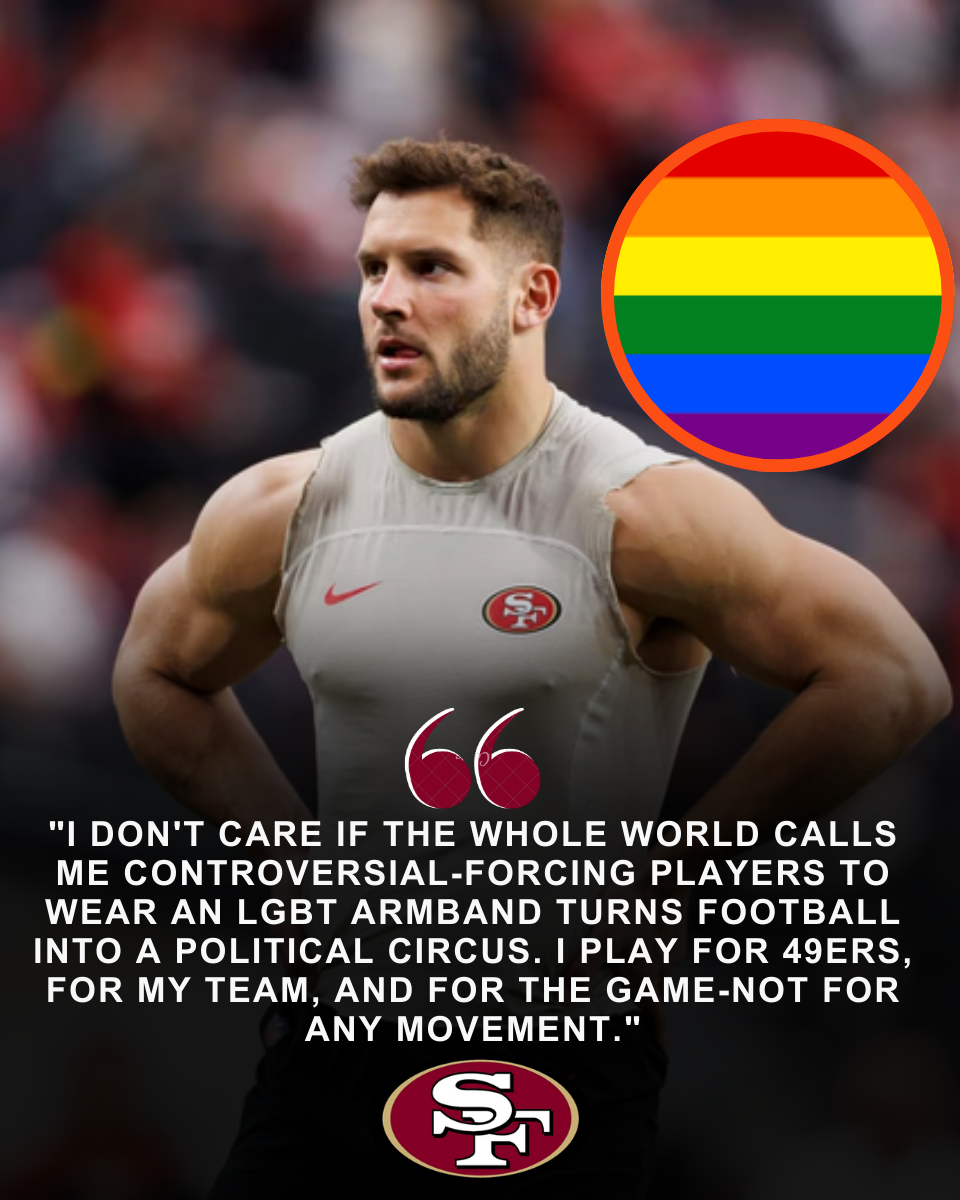
After Declining NFL Pride Armband
A routine pregame initiative has turned into one of the most polarizing moments of the NFL season.
San Francisco 49ers star defensive end Nick Bosa is at the center of a nationwide firestorm after declining to wear the league's Pride-themed armband, reportedly calling it a "political display." The decision — delivered without theatrics or a polished statement — spread across the sports world within minutes.
No buildup.
No coordinated rollout.
Just a refusal — and a sentence that split the football community in two.
According to multiple reports, Bosa informed league officials and team representatives that he would not participate in the Pride-themed initiative, explaining that he plays "for his team and his city — not for movements." The comment quickly moved from locker room conversations to national headlines, igniting debate about personal conviction, league messaging, and the evolving role of athletes in social conversations.
A League at the Intersection of Sports and Culture
The NFL has, over the past decade, increasingly embraced league-wide initiatives tied to social causes — from "Crucial Catch" cancer awareness campaigns to "Salute to Service" military tributes and Pride Month celebrations supporting LGBTQ+ inclusion.
Participation in these campaigns is often visible through helmet decals, sideline apparel, warm-up gear, or armbands. While many players choose to participate enthusiastically, others have historically opted out of certain initiatives without public attention.
What makes Bosa's situation different is the scale and speed of the reaction.
This wasn't about sacks.
It wasn't about scheme adjustments.
It was about identity — and where players draw their lines.
Immediate Reactions Inside and Outside San Francisco
Inside the 49ers organization, reactions appeared measured. Some teammates declined to comment. Others emphasized the importance of unity within the locker room, noting that professional sports often require balancing personal beliefs with collective goals.
Publicly, the debate fractured along familiar lines.
Supporters praised Bosa for standing firm in what they described as personal conviction. Many framed the decision as an example of individual freedom, arguing that participation in league initiatives should remain voluntary.
"Athletes shouldn't be forced into symbolic gestures," one commentator posted. "Respect means respecting choice."
Critics, however, viewed the move differently. LGBTQ+ advocates and several sports analysts argued that Pride initiatives are designed to signal inclusion — particularly in environments where some fans and players have historically felt marginalized.
"When players opt out publicly, it sends a message — intentional or not," one analyst noted on a national sports broadcast.
Within hours, hashtags referencing Bosa and the 49ers trended nationally. Sports talk shows pivoted entire segments to the controversy. Comment sections swelled with debate.
The Platform Question
At the heart of the controversy lies a larger question the NFL has wrestled with for years: What responsibilities come with visibility?
Professional athletes occupy a uniquely powerful cultural platform. Millions watch. Millions listen. Sponsors, leagues, and communities often expect players to reflect certain shared values.
But players, increasingly vocal about personal autonomy, also push back against being viewed as representatives of every initiative.
Bosa reportedly addressed that tension directly: "I respect everyone. But I'm here to play football."
That sentence — simple, direct — became the flashpoint.
For some, it reflects a desire to keep sports separate from social messaging. For others, it overlooks how deeply sports and culture are already intertwined.
A Pattern in Modern Sports
This moment is not occurring in isolation. Across professional leagues, athletes have taken visible stands — both in support of and in opposition to various social causes. Some kneel. Some speak. Some decline participation.
What's changed is the amplification.
In the social media era, even a quiet refusal can become a national story within minutes. Screenshots circulate. Commentary accelerates. Narratives solidify before official statements emerge.
Bosa's stance, whether intended to spark debate or simply express personal belief, illustrates how even restrained decisions now echo far beyond the field.
The NFL's Balancing Act
For the league, situations like this test the balance between promoting inclusion initiatives and respecting individual expression.
The NFL has consistently framed Pride campaigns as affirmations of welcoming spaces within football. League messaging emphasizes that participation is encouraged but not mandated.
Still, public perception often blurs that distinction.
When a star player declines, it becomes more than a personal decision. It becomes symbolic — interpreted through political, cultural, and generational lenses.
And in a league built on collective effort inside the huddle, the debate outside it has rarely felt louder.
What Happens Next?
As of now, the 49ers organization has not announced any disciplinary action, and league officials have reiterated that participation in themed initiatives remains voluntary.
The larger question may not be about consequences — but about precedent.
Will more players publicly opt out of future campaigns?
Will teams establish clearer guidelines on messaging?
Or will this moment fade as the season shifts focus back to matchups and standings?
For now, one thing is clear:
This isn't just about an armband.
It's about how sports intersect with culture.
It's about personal conviction in a hyper-visible league.
And it's about how every decision — even a quiet refusal — can ripple nationwide.
In today's NFL, the spotlight doesn't end at kickoff.
Sometimes, the loudest debates begin before the game even starts.
#NFL #NickBosa #49ers #FootballAndCulture #LeagueDebate